Free Octopus Baby Mobile Crochet Pattern: Ocean Nursery
FREE CROCHET PATTERN • CROCHET FAVORITES
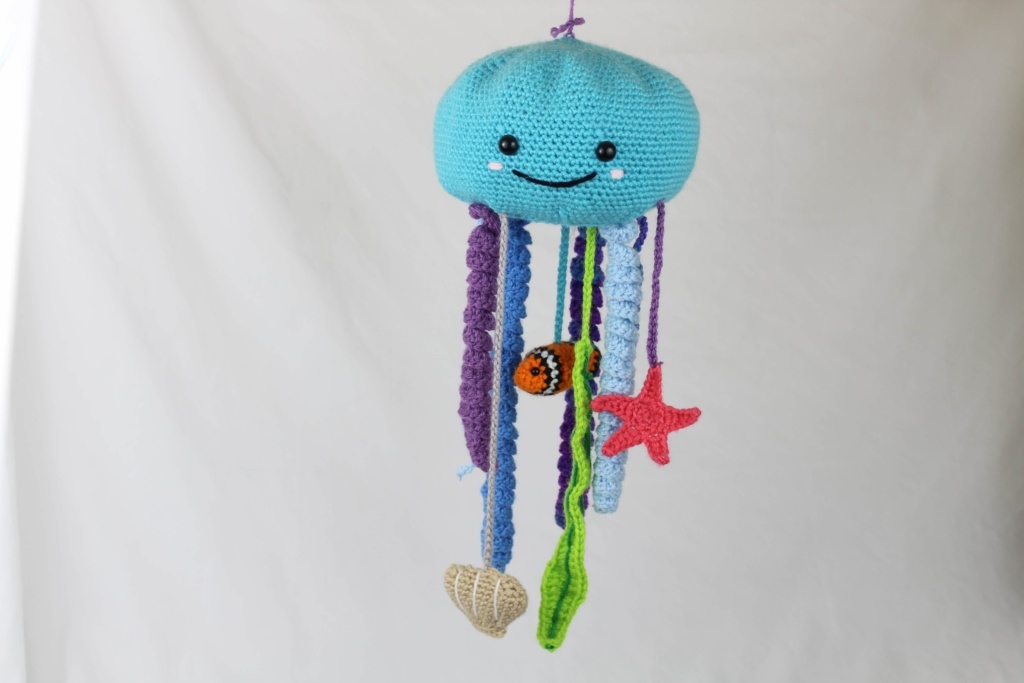
This ocean mobile turns one large stuffed octopus into the support for an entire underwater scene. Six tentacles create the movement, while a clownfish, seaweed, seashell and starfish give the hanging layout enough variety to feel playful instead of repetitive.
The octopus acts as the central hub for six tentacles and four sea-life motifs.
PRINTABLE PDF
The Nursery Dreams 3-in-1 printable PDF also includes the Fairy & Star and Velvet Rainbow Dot mobiles. Add the Etsy product link here before publishing.
Project at a Glance
| Suggested level | Intermediate — many shaped pieces and color changes |
| Sample hook | 4.0 mm |
| Yarn | Weight not specified; use yarn that makes a dense fabric with a 4 mm hook |
| Main hub | Stuffed blue octopus |
| Hanging pieces | 6 tentacles + seaweed + clownfish + shell + starfish |
| Finished size | Custom — depends on yarn and hanging lengths |
| Terminology | US crochet terms |
Materials
4.0 mm crochet hook (sample size)
Yarn in light blue, dark blue, bright blue, off-white, white, purple, orange, black, coral, light green and dark green, or your own palette
Polyester fiberfill
Embroidery thread for facial details
Optional small safety eyes for decorative display only
Yarn needle
Scissors
Stitch marker
Strong yarn or cord for the top suspension
INFANT-FACING FINISH
For nursery decor, embroidered eyes avoid removable small parts. Keep the completed mobile completely out of reach.
Abbreviations
| MR | magic ring |
| ch | chain |
| sc | single crochet |
| hdc | half double crochet |
| dc | double crochet |
| tr | treble crochet |
| inc | increase |
| dec | decrease |
| BLO | back loop only |
| R | round / row |
Full Ocean Octopus Mobile Pattern
Build order: make the octopus hub first, then all hanging motifs, then assemble only after every strand is ready.
1. Octopus Head — R1 to R20
Work in blue.
| Round | Stitch sequence | Sts |
| R1 | 6 sc in MR | 6 |
| R2 | inc around | 12 |
| R3 | (inc, sc) around | 18 |
| R4 | (inc, 2 sc) around | 24 |
| R5 | (inc, 3 sc) around | 30 |
| R6 | (inc, 4 sc) around | 36 |
| R7 | (inc, 5 sc) around | 42 |
| R8 | (inc, 6 sc) around | 48 |
| R9 | (inc, 7 sc) around | 54 |
| R10 | (inc, 8 sc) around | 60 |
| R11 | (inc, 9 sc) around | 66 |
| R12 | (inc, 10 sc) around | 72 |
| R13-R20 | sc around | 72 |
2. Octopus Head — Shape & Close
| Round | Stitch sequence | Sts |
| R21 | (dec, sc 10) around | 66 |
| R22-R32 | sc around | 66 |
| R33 | (dec, sc 9) around | 60 |
| R34 | (dec, sc 8) around | 54 |
| R35 | (dec, sc 7) around | 48 |
Fasten off and stuff firmly. Add the eyes, cheeks and embroidered mouth before the bottom is sewn on.
3. Bottom Circle
| Round | Stitch sequence | Sts |
| R1 | 6 sc in MR | 6 |
| R2 | inc around | 12 |
| R3 | (inc, sc) around | 18 |
| R4 | (inc, 2 sc) around | 24 |
| R5 | (inc, 3 sc) around | 30 |
| R6 | (inc, 4 sc) around | 36 |
| R7 | (inc, 5 sc) around | 42 |
| R8 | (inc, 6 sc) around | 48 |
| R9 | (inc, 7 sc) around | 54 |
| R10 | (inc, 8 sc) around | 60 |
Test the bottom circle against the opening. If it is too small for your tension, continue the same increase sequence until it sits neatly inside the edge. The stitch counts do not need to match one-for-one when you sew the circle to the head opening.
4. Tentacles — Make 6
| Tentacle | Instructions |
| 1 | Medium purple: ch 50; 3 dc in each chain across. Twist after finishing. |
| 2 | Dark blue: ch 80; 3 dc in each chain across. Twist. |
| 3 | Variegated purple: ch 70; 3 dc in each chain across. Twist. |
| 4 | Variegated purple: ch 60; 2 sc in each chain across. Do not twist. |
| 5 | Light blue: ch 60; 3 dc in each chain across. Twist. |
| 6 | Light blue: ch 60; 2 sc in each chain across. Do not twist. |
PLACEMENT
Alternate tight curls and straighter strands. Leave room between tentacles for the four sea-life motifs so the mobile does not read as one dense curtain.
5. Seaweed
Row 1 — first side of chain
Ch 56. Starting in 2nd ch from hook: sc in next 4 ch; [hdc 2, dc 3, hdc 2, sc 3] x2; hdc 4; dc 5; tr 4; dc 3; hdc 5.
Return along the other side
Ch 1 and work along the opposite side of the foundation chain: hdc 5; dc 3; tr 4; dc 5; hdc 4; [sc 3, hdc 2, dc 3, hdc 2] x2; sc in last 4.
Finish
With dark green yarn, sew a decorative line down the center.
Join green yarn at the top and chain to your preferred hanging length.
Leave a secure tail for attaching to the octopus base.
6. Clownfish — Body
| Round | Stitch sequence | Sts |
| R1 | Orange: 4 sc in MR | 4 |
| R2 | inc around | 8 |
| R3 | sc around | 8 |
| R4 | (inc, sc) around | 12 |
| R5 | Black: sc around | 12 |
| R6 | White: (inc, 2 sc) around | 16 |
| R7 | Black: sc around | 16 |
| R8-R12 | Orange: sc around | 16 |
| R13 | Black: sc around | 16 |
| R14 | White: (dec, sc 2) around | 12 |
| R15 | Black: sc around | 12 |
| R16 | Orange: (dec, sc 1) around | 8 |
| R17 | sc around | 8 |
| R18 | dec around | 4 |
Stuff before the final decreases. Four decreases worked over 8 stitches in R18 leave 4 stitches.
7. Clownfish — Tail, Fins & Hanging Cord
Tail
| Round | Stitch sequence | Sts |
| Start | Orange: ch 4 | — |
| R1 | From 2nd ch: sc 3; continue on opposite side with sc 3 | 6 |
| R2 | sc around | 6 |
| R3 | inc; sc 2; inc; sc 2 | 8 |
| R4 | Black: sc around | 8 |
Fasten off, sew the tail closed, then pin and sew it to the fish body.
Fins — make 2
| Round | Stitch sequence | Sts |
| R1 | Orange: 4 sc in MR | 4 |
| R2 | inc around | 8 |
| R3 | sc around | 8 |
Flatten each fin, sew closed and attach to the sides. Add small eyes or embroider them. Join yarn to the top of the fish and chain to the desired hanging length.
8. Seashell
| Round | Stitch sequence | Sts |
| Start | Off-white/tan: ch 8 | — |
| R1 | From 2nd ch: sc 7; continue on opposite side with sc 7 | 14 |
| R2 | BLO: sc around | 14 |
| R3 | inc; sc 6; inc; sc 6 | 16 |
| R4 | sc around | 16 |
| R5 | inc in next 2 sts; sc 6; inc in next 2 sts; sc 6 | 20 |
| R6 | sc around | 20 |
| R7 | sc 1; inc in next 3 sts; sc 7; inc in next 3 sts; sc 6 | 26 |
| R8-R10 | sc around | 26 |
| R11 | sc 2; dec x3; sc 7; dec x3; sc 5 | 20 |
| R12 | sc 2; dec x2; sc 6; dec x2; sc 4 | 16 |
| R13 | sc 3; fasten off, leaving a long sewing tail | — |
Stuff lightly. With white yarn, sew several vertical lines across the shell and pull gently to create ridges. Join gray yarn at the top and chain to the desired hanging length.
9. Starfish
| Round | Stitch sequence | Sts |
| R1 | Coral: 6 sc in MR | 6 |
| R2 | inc around | 12 |
Five points
For the first point: sc in first stitch, ch 7; from 2nd ch work sc, hdc 2, dc 2, tr 1. Skip the next base stitch and sc into the following stitch. Repeat the same point sequence four more times. Fasten off. Join purple yarn at the top of the starfish and chain to the desired hanging length.
SPACING NOTE
Five points use 10 of the 12 center stitches, leaving 2 center stitches unused. Preserve the five-point spacing rather than forcing an extra point.
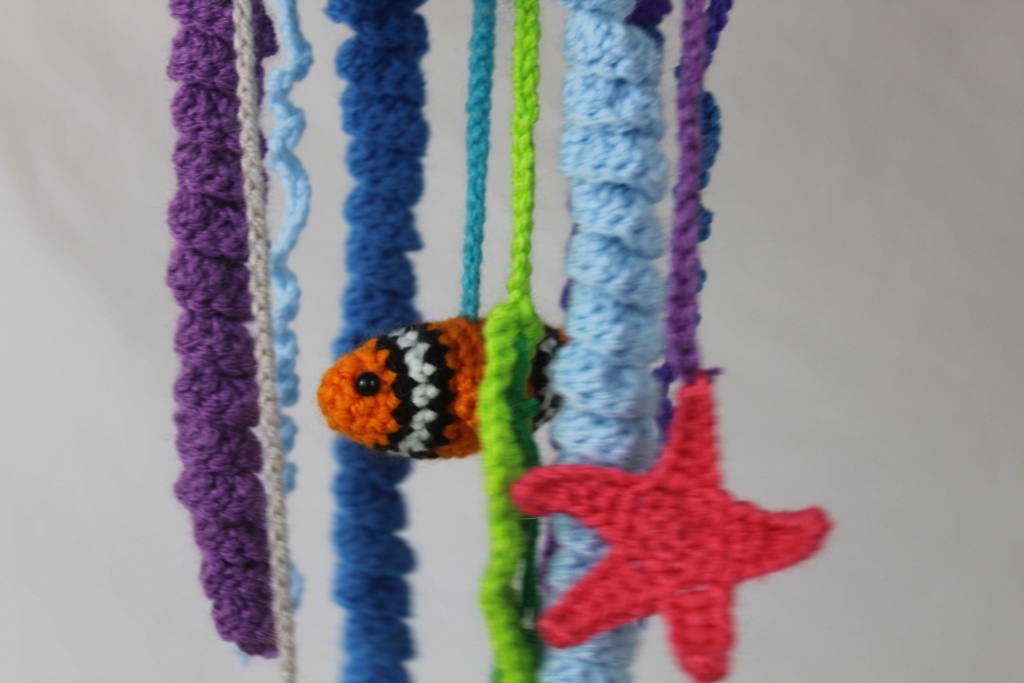
Vary the tentacle textures and hanging lengths so the small sea motifs remain visible.
10. Assemble the Ocean Mobile
Place the stuffed octopus face-up and pin the six tentacles evenly around the lower edge or base.
Add the seaweed, clownfish, shell and starfish strands between the tentacles. Vary the lengths so each motif remains visible.
Sew every tentacle and motif strand securely into the base area.
Position the bottom circle inside the head opening and sew around the edge. Ease the different stitch counts together evenly.
Add a strong hanging loop or cord at the exact top center of the octopus head.
Lift the mobile, check that the face hangs level, then adjust any hanging lengths before trimming or hiding tails.
BALANCE TEST
If the octopus tilts, do not add weight. Shift the top suspension point a few millimeters toward the lighter side or redistribute one hanging strand.
Ocean Color & Layout Ideas
| Palette | Colors |
| Soft nursery ocean | Dusty teal + cream + sand + muted coral + lavender |
| Deep sea | Navy + turquoise + sea green + white + coral accent |
| Sunset reef | Peach + rust + lilac + pale aqua + warm cream |
Keep the longest straight or lightly curved elements toward the middle and place tighter curls toward the outer edges. The fish, shell and starfish look better at different heights than on one horizontal line.
Nursery Safety
This is decorative nursery decor, not a toy. Keep the octopus, cords and every hanging motif completely out of reach. Do not place loose crochet pieces inside the crib. Check the top suspension and attachment points regularly, and remove the mobile from the crib area by 5 months or when the baby pushes up on hands and knees, whichever comes first.
FAQ
What skill level is the octopus mobile?
Intermediate is a good target because the project combines a large stuffed hub, multiple shaped motifs, color changes and final balance.
What yarn weight should I use?
The reference project does not specify a yarn weight. Use a yarn that creates a dense amigurumi fabric with your hook; the sample uses a 4 mm hook.
Can I change the sea-life colors?
Yes. The layout works well with muted nursery palettes, deep ocean colors or warm reef-inspired combinations.
Why does the clownfish finish with 4 stitches in R18?
R17 has 8 stitches. A full round of decreases works four decreases over those 8 stitches, leaving 4 stitches.